
In short
- Designed by Estonian architects Raine Karp and Riina Altmäe.
- Built as a massive sailing venue for the 1980 Olympics.
- Originally named the V. I. Lenin Palace of Culture and Sports.
In this article
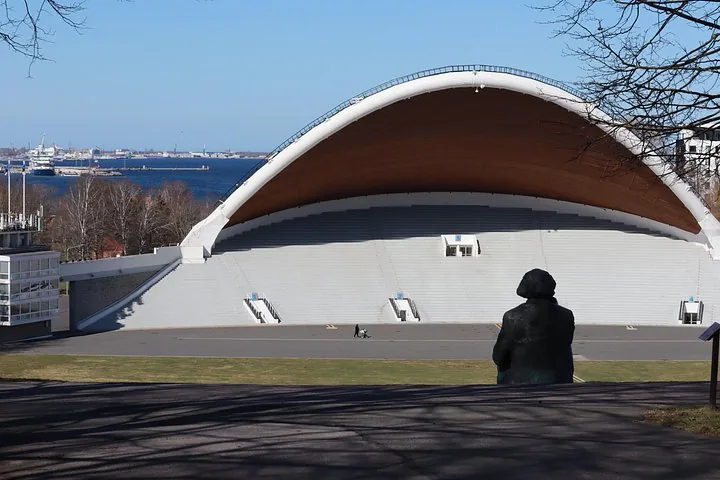
Today, Linnahall sits as a massive concrete relic on the edge of the Baltic Sea. You can explore its exterior steps and terraces for free at any time. Behind the raw concrete lies a highly specific Soviet history.
Why was Tallinn Linnahall built?
The Soviet Union built Linnahall specifically to host the sailing regatta events for the 1980 Moscow Summer Olympics.
Moscow, the host city for the 1980 Games, lacked a suitable coastal venue for sailing. The Soviet government chose Tallinn, situated right on the Gulf of Finland, to hold the regatta. Construction took place between 1976 and 1980. The venue officially opened under the name V. I. Lenin Palace of Culture and Sports.
Who designed the Linnahall in Tallinn?
Estonian architects Raine Karp and Riina Altmäe designed Linnahall in a monumental brutalist style.
The structure features sprawling raw-concrete terraces and staircases. Its low, flat profile was designed to resemble an ancient ziggurat. This layout prevented the massive building from blocking views of Tallinn's medieval Old Town from the sea. It also integrated a small seaport and an operational heliport into the coastal edge.
What was inside Linnahall originally?
The interior housed a 4,200-seat amphitheater-style concert hall and a 3,000-seat ice rink.
The massive main concert hall used local limestone in its design. The adjacent ice hall served as a primary venue for Tallinn's winter sports and community events. Both venues operated for decades after the Olympics ended. Structural deterioration eventually forced both spaces to close.
| Feature | Capacity | Closing Year |
|---|---|---|
| Main Concert Hall | 4,200 seats | 2010 |
| Ice Rink | 3,000 seats | 2009 |
Is Linnahall completely abandoned?
The vast interior is now mostly abandoned, but the exterior remains fully accessible to the public.
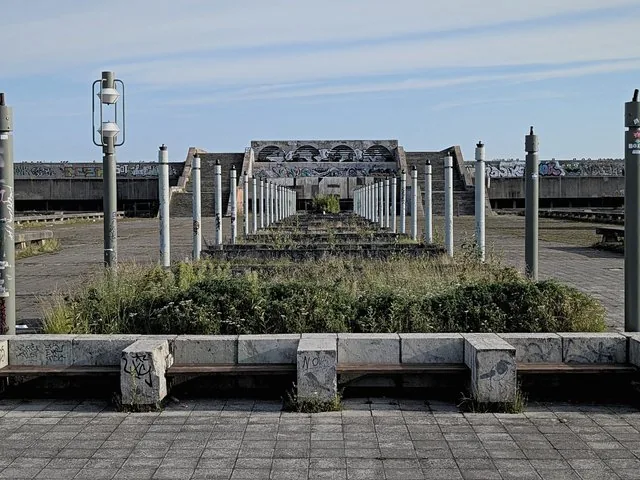
After closing its main venues in 2009 and 2010, the building suffered from neglect. Concrete surfaces show heavy weathering, cracks, and exposed rebar. Sections of the exterior walls now feature modern street art. While the interior sits empty, the exterior steps and flat rooftop plaza remain popular gathering spots.
What movies were filmed at Linnahall?
Linnahall served as a major filming location for Christopher Nolan's 2020 film 'Tenet'.
The production crew utilized the abandoned 4,200-seat amphitheater. In the movie, this space stood in for the Kyiv Opera House. The raw 1980s Soviet aesthetics and dusty corridors provided a dramatic backdrop for the film's sequences.
Are there guided tours of Linnahall's interior?
Yes, the Estonian Centre for Architecture occasionally offers guided tours of the abandoned interior.
These official tours allow visitors to legally access the locked spaces. Tickets typically cost between €15 and €25. Guides lead groups through the dormant ice hall, vintage corridors, and the massive main amphitheater. The exterior is free and usually open to walk on, though some parts are fenced off.
Questions travellers ask
Can you go inside Linnahall in Tallinn?
You can only enter the interior through an official guided tour. The Estonian Centre for Architecture occasionally runs these tours. Accessing restricted interior areas on your own is prohibited.
Is Linnahall free to visit?
Yes, exploring the exterior steps, terraces, and rooftop promenade is completely free. Guided tours of the interior charge a fee, typically ranging from €15 to €25.
How long does it take to visit Linnahall?
Walking the exterior steps and taking photos usually takes 30 to 45 minutes. If you book an official interior tour, expect to spend much longer exploring the vintage corridors and large halls.